editorial guide · September 29, 2026
Dream11 IPL Deadline Checklist: 60 minutes before the toss
Written by the Dream11 App Editorial Team
This guide has been reviewed for clarity, India-market accuracy, and consistency with public reference pages.
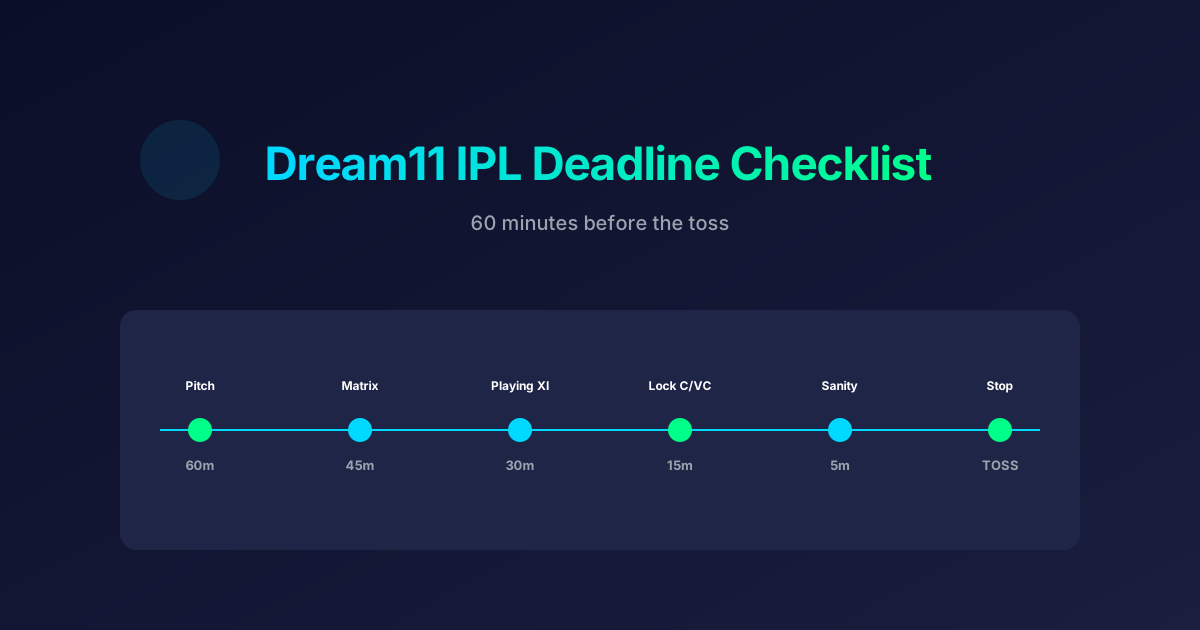
A dream11 deadline is the contest lock at the toss — and this dream11 deadline checklist is the 60-minute workflow you run before that lock on every IPL fixture, with steps you can repeat for T20 and ODI matches in the same template.
It is 60 minutes before the IPL toss. Your Dream XI is half-built. You have a dream11 captain candidate, a vice-captain candidate, and three bowlers you haven't decided between. The playing XI is not announced yet. The pitch report was published three hours ago. What do you do, in what order, in the next 60 minutes before the dream11 deadline?
This checklist is the answer. It is the same checklist we use in our own strategy pages, written for the most common IPL fixture: evening match, 7:30 p.m. start, contest deadline at the toss. If your dream11 deadline is earlier (some marquee matches lock 10-15 minutes before the toss), start this checklist 75 minutes before the toss instead.
The 60-minute timeline
| Time before toss | Action | Why it matters |
|---|---|---|
| 60 minutes | Pull the pitch report and weather forecast | Confirms whether the venue is batting-friendly or bowler-friendly, whether dew is expected |
| 45 minutes | Re-score the captain matrix for your top three candidates | The pitch and weather inputs change venue-fit and role-stability scores |
| 30 minutes | Wait for the playing XI announcement | Confirms your captain candidate is in the XI; flags players who might be rested |
| 15 minutes | Lock captain and vice-captain | Captain differential matters most in mega contests — lock when your read is freshest |
| 5 minutes | Final sanity check on credit budget, role balance, contest room | Catches last-minute slips before the contest locks |
| Toss → deadline | Stop editing | The official contest locks here in most rooms |
Each step takes about 5-10 minutes; the rest of the time is waiting. The waiting is the discipline.
Step 1 — 60 minutes: pull the pitch report and weather forecast
The morning pitch report from Cricbuzz or ESPNcricinfo usually tells you three things: grass cover, expected turn, and pace behaviour. The evening weather forecast tells you whether dew is likely.
| Pitch + weather signal | Implication for your Dream XI |
|---|---|
| Dry, no grass, dew expected | Spinners struggle in the second innings; pace bowlers who bowl cutters lose grip |
| Green grass, no dew | Pacers get seam movement early; spinners can hold their grip longer |
| Flat, even grass, dry weather | Batters dominate; bowlers need wicket-taking deliveries, not containment |
| Dusty, dry, no dew | Spinners dominate, especially in the second innings when the surface dries further |
These are starting inputs, not conclusions. Combine them with the venue's average first-innings score from the last 3-5 matches there — that gives you the real expectation.
Step 2 — 45 minutes: re-score the captain matrix
Take the four-factor captain matrix and re-score your top three captain candidates with the pitch and weather inputs in mind. The pitch + weather primarily change the venue & conditions fit factor and may change the score ceiling factor (a batting paradise lifts ceilings for batters, drops them for bowlers).
If your top candidate is still top after the re-score, the matrix is consistent. If a different candidate jumps ahead, the new conditions have shifted your read — go with the new top candidate, not the old one.
The most common pitch-driven swap: a top-order batter you planned to captain becomes a second-pick on a flat pitch (because the ceiling is shared with several batters), and a strike pacer on a green-top pitch jumps to captain. Trust the re-score, not your pre-pitch gut feel.
Step 3 — 30 minutes: wait for the playing XI
IPL teams usually announce the playing XI 30-60 minutes before the toss, on their official social media accounts. The announcement tells you:
- Is your captain candidate playing? If not, they are out of your Dream XI. Substitute with the next-best candidate from the matrix.
- Is your differential pick in the XI? A differential captain who sits on the bench is a wasted slot.
- Are there surprise inclusions or exclusions? A young player brought in for a senior player changes role distribution — that affects the bowling captaincy if the senior was a frontline bowler.
- Did the team change the batting order? Top-order shuffles affect your top-order bat captain pick.
While you wait, use the time to re-check the contest room you want to enter. If your captain pick is now clearly a differential (low ownership, good fit), a mega contest is the right room. If your captain pick has become mainstream (high ownership, consensus captain), a small league or H2H is the right room.
Step 4 — 15 minutes: lock captain and vice-captain
In a 15-minute window, the temptation is to overthink. Don't. The matrix already gave you the answer at the 45-minute mark; the playing XI confirmed or denied your top candidate; the toss is in 15 minutes and the deadline is at the toss.
Lock the captain and vice-captain now. Edits in the last 15 minutes are almost always emotional — a headline number you saw on Twitter, a tip from a friend, a panic swap because a player you didn't pick just hit a fifty in the warm-up. None of these are inputs the matrix could have used.
If you entered multiple contests for this fixture, lock the same captain across all of them. Changing captains between contests in the same fixture is hedging with yourself — it dilutes your edge without raising it.
Step 5 — 5 minutes: final sanity check
Run through these six checks in order. Each takes about 30 seconds.
- Role balance: 1 wicket-keeper, 3-5 batsmen, 1-3 all-rounders, 3-5 bowlers. Does your XI match the contest's role requirement?
- Credit budget: Total credits used must be ≤ 100. Is your XI exactly at the cap, or did a swap leave 0.5 credits unspent? (Don't try to chase the last 0.5 — it doesn't matter.)
- Captain and vice-captain are different players. This sounds obvious. It happens. Confirm.
- Captain and vice-captain are not from the same fragile role. If both are from the same pace attack on a flat pitch, the toss impact guide explains why this is a hedge mistake.
- You are in the contest room you planned to enter. Mega contest, small league, H2H, practice — the room should match your confidence read.
- Your daily contest budget has room for the entry fee. If the budget is spent, you should not be entering new contests in this fixture.
If any check fails, fix it. If all checks pass, stop editing.
Step 6 — Toss → deadline: stop editing
The toss happens. The contest deadline is typically the toss itself (sometimes 1-2 minutes after for late announcements). Your Dream XI is now locked. Anything you wanted to change — a bowler swap for dew, a captain change for the toss — is now in the next contest, not this one.
Do not open the team preview to "see what happens." The preview will tempt you to second-guess the lock. Walk away from the screen; the match will tell you if the read was right.
Common deadline-checklist mistakes
- Building the team in the last 10 minutes. A team built under time pressure is built on emotion, not on the matrix. Start the checklist 60 minutes before the toss, not 10 minutes before.
- Chasing the last 0.5 credits. The 0.5-credit upgrade from player X to player Y is rarely a 0.5-point swing. Stop optimising the marginal case.
- Editing after a bad beat. If your captain failed in the last match, the temptation is to over-correct in this match. The matrix is match-independent; the read should be too.
- Ignoring the contest budget. A daily budget of ₹500 is ₹500, not "₹500 plus this one extra contest". The discipline is to stop when the budget is gone, not when the temptation runs out.
- Using practice contests as a substitute for the checklist. Practice contests let you test the matrix; they do not replace the deadline discipline. A real-money contest with a 60-minute head start beats a real-money contest with a 10-minute panic build.
How Dream11App uses this guide
This checklist is built from the frameworks on our site: the captain matrix, the contest room choice, and the toss impact analysis. We do not host contests or take deposits. We publish independent explainers so Indian fantasy cricket players can build defensible Dream XI decisions, not promises.
If you want a deeper read on the matrix logic, the captain decision matrix walks through the four factors in detail. The toss impact guide explains what changes between the playing XI announcement and the deadline.
Frequently asked questions
When does the Dream11 contest lock for IPL matches? The contest deadline is typically the toss, sometimes 1-2 minutes after for late announcements. Some marquee matches lock 10-15 minutes before the toss. Check the specific contest rules on the official product.
When are IPL playing XIs announced? IPL teams usually announce their playing XIs 30-60 minutes before the toss, on their official social media accounts. Some teams announce later; some announce on the field at the toss.
Where can I find the pitch report for an IPL match? Cricbuzz and ESPNcricinfo publish pitch reports for IPL matches on the morning of the fixture, including grass cover, expected turn, and pace behaviour. Combine the pitch report with the venue's average first-innings score from the last 3-5 matches.
What if the playing XI is announced after my captain matrix? Re-score the matrix with the confirmed XI. If your top captain candidate is not in the XI, drop them from the matrix and re-rank. Lock the new captain within 15 minutes of the playing XI announcement.
Can I edit my Dream XI after the toss? In most contests, no. The deadline passes at the toss. The toss impact guide explains what to do in the small window before the toss if the contest allows it.